

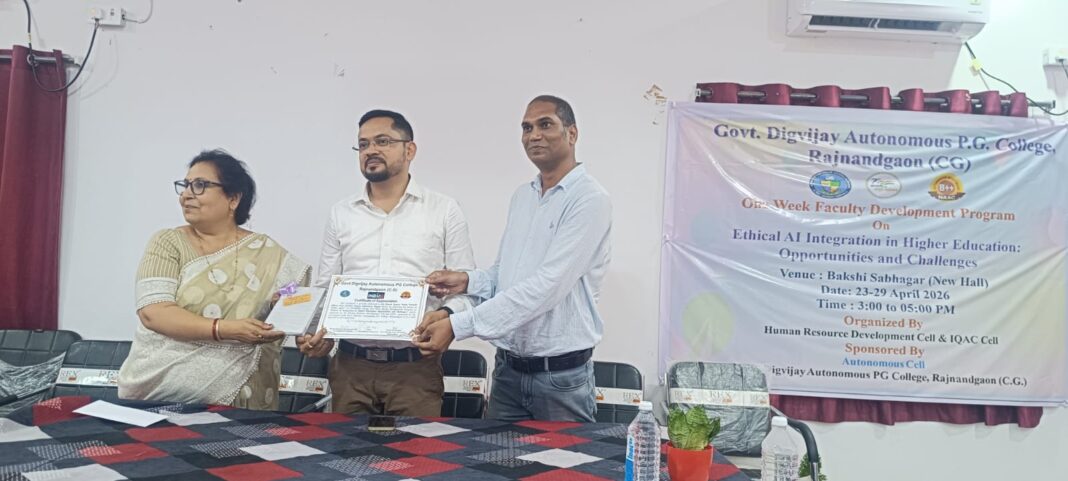

Faculty Development Programme highlights ethical AI integration and growing cyber security challenges in higher education
Published on: April 28, 2026
By: BTNI
Location: Rajnandgaon, India
The fourth day of the week-long Faculty Development Programme titled “Ethical AI Integration in Higher Education: Opportunities and Challenges” was successfully organized at Government Digvijay Autonomous Postgraduate College, Rajnandgaon (Chhattisgarh). The programme was conducted jointly by the Human Resource Development Cell (HRDC) and the Internal Quality Assurance Cell (IQAC).
The initiative aims to enhance understanding of the ethical use of Artificial Intelligence (AI), its possibilities, and the emerging challenges associated with technological advancement in higher education. Active participation from teachers, research scholars, and students has made the programme informative and impactful.
Focus on Ethical AI and Digital Awareness
The academic programme is being organized to promote awareness about responsible technological adoption in educational institutions. Participants are being introduced to practical and ethical dimensions of Artificial Intelligence while also addressing risks linked with digital transformation.
The fourth day’s major attraction was an expert lecture on the highly relevant topic of cyber crime.
Expert Address by Cyber Forensics Specialist
Dr. Dinesh Kumar, Senior Scientific Officer at the State Forensic Laboratory, Raipur (Chhattisgarh), attended the programme as the keynote speaker. The session began with a formal welcome of the chief guest by Dr. P. B. Taunk, who emphasized in his welcome address that cyber crime has emerged as a serious challenge in the modern digital era and that awareness and knowledge are essential to combat it.
During his lecture, Dr. Dinesh Kumar explained the concept of cyber crime in simple terms, describing it as illegal activities carried out through computers, the internet, or other digital platforms. He highlighted that with the rapid growth of digital technologies, both the number and complexity of cyber crimes are increasing.
Also read-
- Newborn Delivered Safely Inside Moving 108 Sanjeevani Express
- Mayor Madhusudan Yadav Launches Intensified Pulse Polio Campaign 2026
- Assembly Speaker Dr. Raman Singh Inaugurates Passenger Waiting Shelter in Mohara
- Prime Minister’s Simple and Direct Interaction Instils Confidence Among Farmers: Komal Singh Rajput
- Rajasthan CM Bhajanlal Sharma Pays Homage to Haldighati’s Sacred Soil Amid Maharana Pratap Anniversary Celebration
Understanding Types of Cyber Crimes
Dr. Kumar elaborated on various forms of cyber crimes, including phishing, identity theft, data theft, online fraud, hacking, cyber bullying, ransomware attacks, and social engineering.
He explained that phishing attacks often involve fake emails or websites used by criminals to obtain confidential information from users. Similarly, identity theft involves misuse of an individual’s personal data.
He stressed that cyber crime is not limited to financial loss but can also impact personal privacy, mental well-being, and social reputation. Educational institutions, he noted, are increasingly becoming major targets of cyber attacks, making vigilance essential for both teachers and students.
Essential Cyber Safety Measures
Emphasizing cyber security practices, Dr. Kumar advised individuals to remain cautious while using digital platforms. He recommended using strong passwords, changing passwords periodically, enabling two-factor authentication (2FA), avoiding unknown links, and staying alert against suspicious emails.
He further highlighted the importance of installing antivirus software, regularly updating software systems, and using secure internet connections. According to him, awareness remains the most effective tool for preventing cyber crime.
To enhance understanding, he presented several real-life examples and case studies, helping participants clearly grasp the seriousness of cyber threats. He also explained how cyber forensic technologies help identify offenders and how digital evidence is used during judicial proceedings.
Interactive Session and Programme Conclusion
Participants actively engaged in the session by asking questions, which were answered clearly and satisfactorily by the keynote speaker. The interactive discussion made the programme more engaging and knowledge-enriching.
The programme was efficiently conducted by Vandana Mishra, whose structured presentation ensured smooth coordination of all activities.
At the conclusion of the event, the college family presented the chief speaker with a certificate and a Token of Gratitude in recognition of his valuable contribution and insightful lecture. A large number of faculty members of the college were present on the occasion.