


ARTICLE
Written by
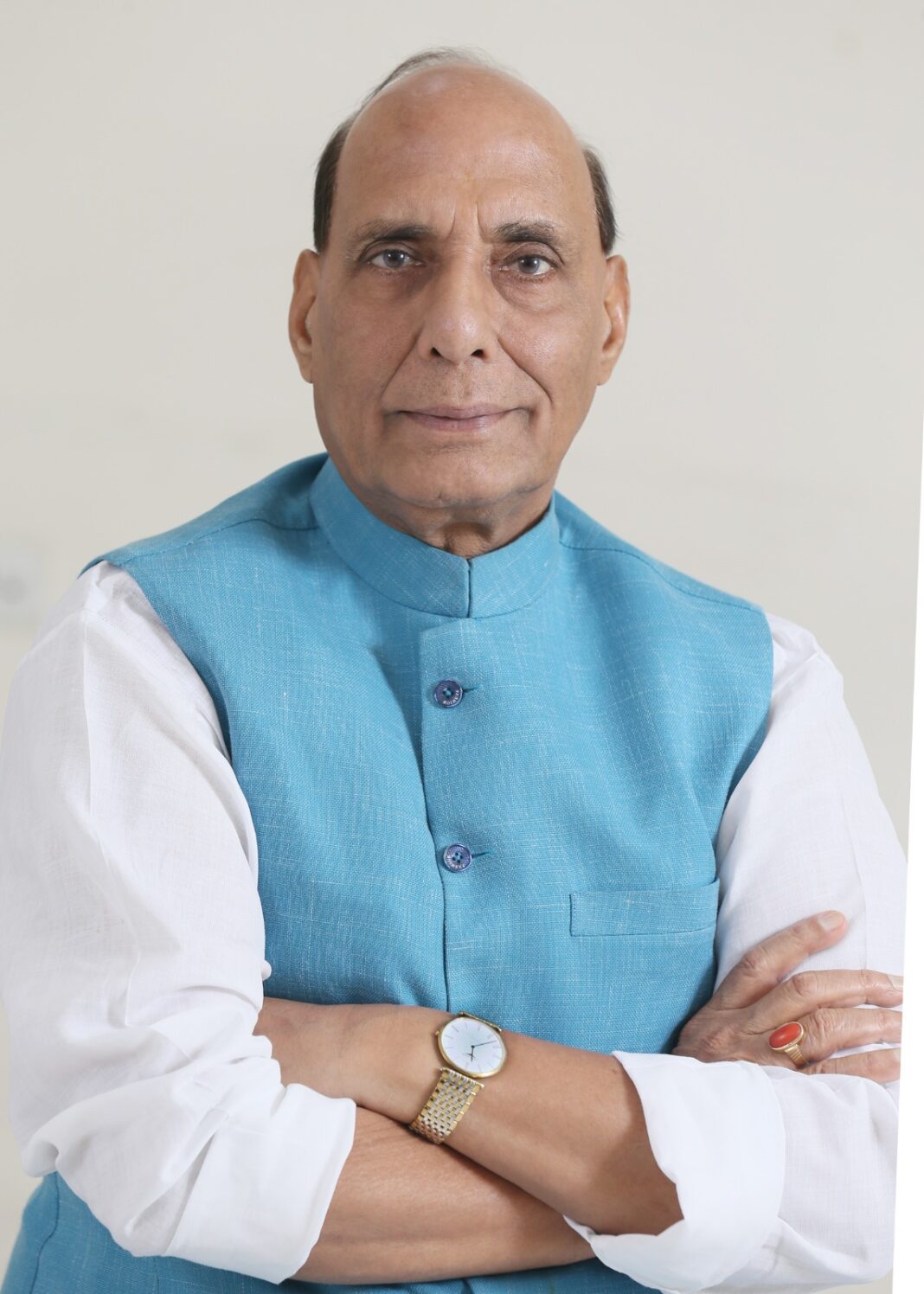
Rajnath Singh, Raksha Mantri
Today marks the 135th birth anniversary of Dr. B.R. Ambedkar, one of India’s greatest visionaries. There have been deliberate and unjust attempts to downplay the legacy of Dr Ambedkar. After more than a century, the greatest injustice to his legacy is to reduce him to a Dalit leader. Today, he should be seen not merely as a symbol of resistance for Dalits and marginalised, which he undoubtedly is and always will be, but also as one of the foremost thinkers of modern India.
It is recorded that when he was at school, he was not even permitted to drink water from the common tap that other children drank from. One day, in the scorching heat, when he decided to drink from the source closest to him, he was assaulted for daring to violate this oppressive taboo. After such an incident, many young boys would have been resigned to their fate. Others may have become reactionary, rebelling against an unjust system through violent action. But Ambedkar channelised his inner angst into a zeal for learning. He went on to get a MA, MSc., PhD, DSc, DLitt and Bar-at-Law, including degrees at Columbia and the London School of Economics. If society wasn’t willing to let him have water from the same tap or study in the same schools, he would bypass them entirely and complete his education abroad. Despite this, he was always clear on returning to India, his matribhoomi and karmabhoomi.
Providence granted Dr Ambedkar unparalleled grit, intellect, and integrity, which he put to use as a social reformer, jurist, economist, philosopher, human rights champion, and nation-builder. The depth, length and breadth of Dr Ambedkar’s scholarship are unparalleled. He wrote extensively on subjects and themes ranging from politics to ethics, sociology to anthropology, from economics to law and from political Economy to theology.
Dr Ambedkar’s role as an institution builder also needs to be highlighted. Several institutions in modern India, such as the RBI and Central Water Commission, find their genesis in the farsightedness of Babasaheb. Building on his mastery of economics and economic history, he analysed the monetary problems facing India in his evidence to the Royal Commission on Indian Currency and Finance. In this thesis, he elaborated on how the system of fixed exchange being maintained by the British served only their interests in India. Ultimately, this became the foundation for the creation of the Reserve Bank of India to perform the functions of a central bank.
Being a staunch democrat that he was, Dr Ambedkar also believed that a democratic form of Government presupposes a democratic form of society. He believed that without moral order in society, there cannot be democracy and the rule of law. It can also be said that for him, democracy, politics, and ethics formed a trinity just like liberty, equality, and fraternity. He held that “You may learn politics and you may know nothing about ethics, as though politics can work without ethics. To my mind, it is an astounding proposition” and “If there is no moral order, democracy will go to pieces.” Like his greatest interlocutor, Gandhiji, Ambedkar was committed to fundamental social reform.
This is because he was deeply worried about the future of India, its democracy, and hard-earned independence. His trepidations found expression in his last speech in the Constituent Assembly. Amid loud cheers, Dr Ambedkar held that we must be determined to defend our independence with the last drop of our blood. He forewarned that India will lose its democracy and independence a second time if Indians become complacent. In one of his addresses in Poona, he said, “We have got a constitution which provides for democracy. Well, what more do we want? … Let me warn you against this kind of smug feeling that with the making of the constitution, our task is done. It is not done. It has only begun.” For the principal architect of the Constitution to say this demonstrates how much of a visionary he truly was.
It is his words of caution that set India on the path of a vibrant democracy for almost eight decades. However today, we see the attempts by some people to reduce the fraternity between Indians based on social cleavages such as caste, religion, ethnicity, language, etc. We should be on guard to ensure that these divisive tendencies remain nothing but failed attempts. Re-reading and re-engaging with the oeuvre of Dr Ambedkar can be our guiding light in this pursuit.
For instance, Ambedkar mocked the Aryan invasion theory at a time when he could have gained most from the Aryan-Dravidian divide. “Whether a tribe or family was racially Aryan or Dravidian was a question which never troubled the people of India until foreign scholars came in and began to draw the line,” Babasaheb wrote in a paper published in 1918. Elsewhere, he cited several instances where the rishis of the Yajur Veda and the Atharva Veda wished glory to Shudras, and on several occasions, a Shudra became the king himself. He also flatly rejected the theory that the untouchables are racially different from the Aryans and the Dravidians.
Furthermore, those who are attempting to use linguistic issues to further their narrow and sectarian interests would greatly benefit by reading Dr Ambedkar’s views on the unity of the nation and the role of a language in this. On 10th September, 1949 he moved an amendment in the Constituent Assembly supporting Sanskrit – one of the nine languages he had mastered – as the official language of the Union. In his ‘Thoughts on Linguistic States’, he also declared it the “bounden duty of all Indians to own up Hindi as their language.” It is to be noted that Babasaheb was not a native Hindi speaker, yet said this because he put the nation first.
In one of his speeches, titled ‘Conditions Precedent for the Successful Working of Democracy’ and given on 22nd December 1952, Dr Ambedkar said that the form and purpose of democracy undergo change over time and the purpose of modern democracy is to bring about the welfare of the people. Working tirelessly with this vision, in the last 10 years, our government has succeeded in lifting 25 crore people out of poverty. We have worked to provide tap water to 16 crore homes. We have built 5 crore houses for poor families. In the year 2023, the Jan Man Abhiyan was started by Prime Minister Shri Narendra Modi Ji. This is aimed at improving the socio-economic conditions of the Particularly Vulnerable Tribal Groups (PVTGs) and saturating PVTG households and habitations with basic facilities. We have also started the ‘Ayushman Bharat Pradhan Mantri Jan Arogya Yojana’ to achieve the vision of Universal Health Coverage (UHC). Our government’s welfare work for the people, under the leadership and guidance of PM Shri Narendra Modi Ji, speaks volumes of our dedication to democracy and our reverence for Babasaheb.
Dr. B. R. Ambedkar believed that social and economic democracy goes hand in hand with political democracy. PM Shri Narendra Modi Ji has set a target of ‘Viksit Bharat’ by 2047. This target conforms to the vision of Babasaheb. Furthermore, to ensure that future generations know more about the legacy and contributions of Babasaheb, our government has worked to develop Panchteerth These five iconic places, associated with Dr. Ambedkar, are Mhow (Madhya Pradesh); Deeksha Bhoomi in Nagpur (Maharashtra); Dr. Ambedkar Memorial Home in London; Mahaparinirvan Bhoomi in Alipur Road (Delhi), and Chaitya Bhoomi in Mumbai (Maharashtra).
Last month, when the PM Shri Narendra Modi Ji visited Deekshabhoomi, he reaffirmed the Government’s commitment to work even harder to realise the India which Babasaheb envisioned. The birth anniversary of Babasaheb presents all Indians with an opportunity to renew our pledge to the values and ideals given by him. Let us rise above our race, religion, region, caste and creed, and be ‘Indian’. To truly honour his legacy, we must engage with the full range and profundity of his thought and resist all attempts to reduce him to the status of a sectarian leader. As he told the Simon Commission when asked to give evidence, the burning need was to create a sense among the people that “they are Indians first and Indians last” warning against giving in to “local patriotism and group consciousness.” Babasaheb is God’s gift to India and India’s gift to the world. Today, 135 years on, let us give him the pedestal that he deserves, that both British India and the newly independent nation denied him.

