

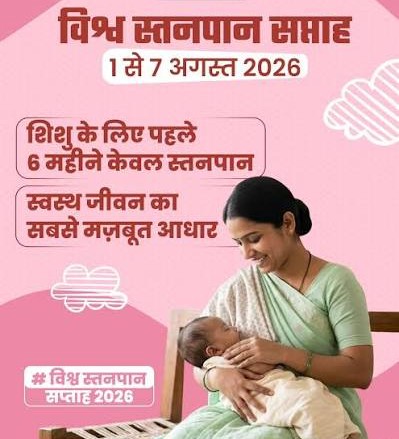

World Breastfeeding Week highlights the importance of early breastfeeding, exclusive feeding for six months, and collective support for mothers and infants
Published on: August 05, 2026
By: Dhananjay Rathore, Joint Director
Location: Raipur, India
World Breastfeeding Week is observed every year from August 1 to 7 to raise awareness about the importance of breastfeeding for infant health. The campaign highlights that initiating breastfeeding within the first hour after birth and providing exclusive breast milk for the first six months are among the most important steps for ensuring a child’s healthy growth and development.
Breastfeeding also promotes skin-to-skin contact between mother and baby, strengthening their emotional bond while providing the infant with comfort, warmth and a sense of security that supports healthy emotional development.
Breastfeeding Protects Infants from Life-Threatening Infections
According to the World Health Organization (WHO) and UNICEF, the first hour after birth and the first six months of life play a decisive role in shaping a child’s future health. Breastfed infants face a lower risk of common childhood illnesses such as diarrhoea, pneumonia, ear infections and certain respiratory infections.
The WHO states that optimal breastfeeding has the potential to prevent millions of infant deaths globally every year by protecting newborns from life-threatening infections.
Colostrum: The Baby’s First Natural Vaccine
The thick yellow milk produced during the first few hours after childbirth, known as colostrum, is described as the newborn’s first natural vaccine. Rich in antibodies, proteins and vitamins, colostrum strengthens a baby’s immune system and provides protection against a wide range of infections.
The period immediately after birth, often referred to as the “Golden Hour,” is considered critical for initiating breastfeeding. During this time, newborns are naturally alert and instinctively seek to breastfeed. Early skin-to-skin contact also helps regulate the baby’s body temperature, heart rate and blood sugar levels while improving successful breastfeeding outcomes.
ALSO READ-
- Rajasthan’s Arundhati Chaudhary Wins Historic Commonwealth Boxing Gold Despite 102°F Fever
- Breastfeeding: A Newborn’s First Shield of Protection and the Foundation of a Healthier Society
- Two-Day Training on Professional Conduct and Mental Resilience Concludes in Rajnandgaon Range
- Over Three Lakh Signatures Submitted from Rajnandgaon Under Gau Samman Ahwan Abhiyan; Memorandum Sent to Government
- Grand Sawan Palki Yatra of Baba Mahakal to Be Taken Out in Rajnandgaon on August 6
Exclusive Breastfeeding for the First Six Months
Doctors and health experts recommend that infants should receive only breast milk from birth until six months of age. During this period, there is no need to provide water, formula milk, honey or any other food or drink, as breast milk contains sufficient water and all essential nutrients required for the baby’s growth and hydration.
After six months, complementary nutritious foods can be introduced while continuing breastfeeding, which may continue for up to two years or beyond.
Multiple Health Benefits of Breastfeeding
Breastfeeding offers significant health benefits for children. It reduces the risk of diarrhoea, pneumonia, ear infections and malnutrition. Studies have shown that breastfed children often experience better cognitive development and mental health compared to those who are not breastfed.
Breastfeeding is also associated with a lower risk of developing chronic conditions such as obesity, diabetes and asthma later in life.
Benefits for Mothers
Breastfeeding is equally beneficial for mothers. It lowers the risk of breast cancer and ovarian cancer, supports postpartum weight loss and helps the uterus return to its normal size after childbirth. It also strengthens the emotional bond between mother and child.
A Shared Responsibility of Families and Society
The article emphasises that breastfeeding is not solely a mother’s responsibility but a shared responsibility of families and society. Lack of awareness, social misconceptions and inadequate workplace support often prevent mothers from breastfeeding on time.
Proper nutrition, adequate rest and mental well-being are essential for mothers after childbirth so they can breastfeed without stress. The article also highlights the need for crèche facilities, maternity leave and breastfeeding breaks at workplaces for working mothers.
It further recommends establishing safe and hygienic feeding rooms at public places such as bus stations, railway stations and shopping malls to support breastfeeding mothers.
Building a Healthier Future
World Breastfeeding Week serves as a reminder that creating an environment where mothers can breastfeed without hesitation or barriers is essential to ensuring every child receives the fundamental right to mother’s milk.
The article concludes that a supportive environment for breastfeeding is key to building a malnutrition-free, healthier and stronger society.


