

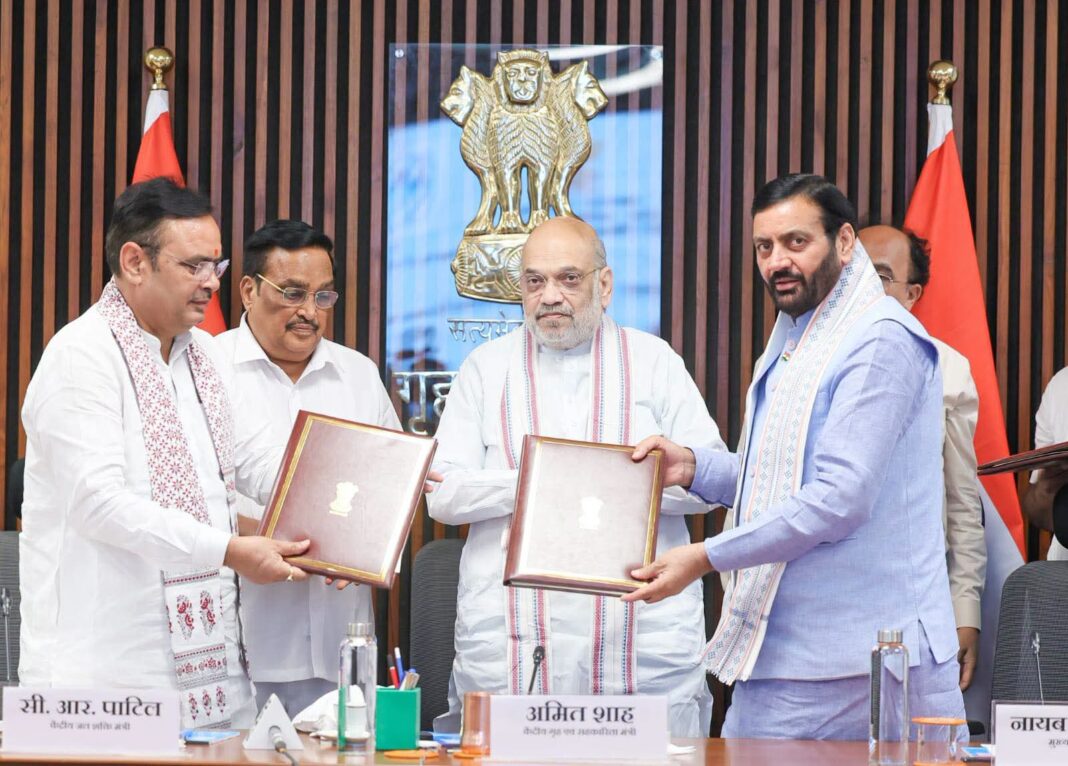

MoA signed in the presence of Union Home Minister Amit Shah paves the way for ₹34,102-crore project expected to transform drinking water security, irrigation and regional development
Published on: July 01, 2026
By: BTNI
Location: New Delhi/Jaipur, India
In what is being regarded as a landmark development in Rajasthan’s water management journey, the long-awaited Yamuna Water Project has moved a decisive step closer to implementation after the Governments of Rajasthan and Haryana signed a Memorandum of Agreement (MoA) for its construction and execution.
The agreement was signed in the presence of Union Home and Cooperation Minister Amit Shah, marking a major milestone in a project that had remained pending for more than three decades. The development is expected to provide a long-term solution to the drinking water needs of millions of people in the Shekhawati region.
The agreement comes nearly 32 years after the Upper Yamuna River Board Agreement of 1994, under which Rajasthan’s share of Yamuna water was originally envisaged. After decades of discussions and administrative processes, the project has now entered the implementation phase.

577 Million Cubic Metres of Water Allocated to Rajasthan
Under the agreement, Rajasthan will receive 577 million cubic metres (MCM) of water from the Yamuna River, equivalent to approximately 1,917 cusecs.
The project proposes the construction of three underground pipelines, each with a diameter of 3.6 metres, extending approximately 295.5 kilometres from the Hathinikund Barrage in Haryana to the Hansiyawas Reservoir in Churu district of Rajasthan.
The total estimated cost of the project is ₹34,102 crore.
Water is proposed to be supplied during the monsoon season from July to October, with allocations intended for drinking water, irrigation and industrial use. According to the agreement, the project will also provide drinking water to 10 locations in Haryana, making it a mutually beneficial initiative for both states.
Major Boost for the Shekhawati Region
Experts believe the project has the potential to significantly improve groundwater levels across Sikar, Jhunjhunu, Churu and the wider Shekhawati region.
Villages that have long depended on water tankers are expected to receive a more reliable drinking water supply. Improved irrigation facilities are also anticipated to enhance agricultural productivity, while better water availability could encourage industrial investment and create new economic opportunities across the region.
ALSO READ-
- Gauri Nagar Cattle Slaughter Case: 10 Named Accused and One Juvenile Arrested, Sent to Jail
- Rajnandgaon Collector Jitendra Yadav and Zila Panchayat CEO Durga Prasad Adhikari’s Simplicity Wins Public Attention
- Political Storm Over the A B Bajpeyee’s (Atal ji) Principle: ‘Differences Are Acceptable, But They Must Not Turn Into Discord’
- Sale of Bhilai Steel Plant: Reports Are False and Misleading, Says BSP
- Political Row in Chhattisgarh BJP: Ramvichar Netam’s Visit to Congress MLA’s Farmhouse Triggers Local Discontent
For an area that has historically faced recurring water scarcity, the project is expected to become a transformative infrastructure initiative.
Outcome of Inter-Governmental Coordination
The agreement has been presented as an example of resolving long-pending issues through dialogue and inter-governmental coordination.
The breakthrough follows the combined efforts of Union Home and Cooperation Minister Amit Shah, Union Jal Shakti Minister C.R. Patil, Rajasthan Chief Minister Bhajan Lal Sharma, and Haryana Chief Minister Nayab Singh Saini, whose coordination helped move the project towards implementation after years of delay.
Long-Term Investment in Rajasthan’s Future
Policy observers believe the Yamuna Water Project represents more than a water supply initiative. It is expected to strengthen the state’s long-term water security, support rural livelihoods, expand opportunities for agriculture and industry, and reduce the impact of recurring water shortages for future generations.
With the signing of the agreement on June 29, 2026, the project enters a new phase that is expected to play a significant role in Rajasthan’s development trajectory and the future of the Shekhawati region.