


Agriculture in Chhattisgarh Gains New Momentum as Crop Diversification, Technology and Market Linkages Reshape the Rural Economy
Published on: September 12, 2026
By: BTNI
Location: Raipur, India
Chhattisgarh has long been known as the “Rice Bowl”, but agriculture in the state is now moving beyond its traditional identity. Under the initiatives of the Vishnu Deo Sai government, efforts ranging from improved farm production and modern technology to irrigation, crop diversification, processing and market access are reshaping agriculture as a broader driver of the rural economy.
The impact is visible not only in crop production but also in horticulture, animal husbandry and fisheries.
Alongside traditional paddy cultivation, farmers in Chhattisgarh are increasingly turning to ginger, marigold, horticulture and fish farming, among other modern and cash-oriented activities. Farmers are moving beyond paddy and earning significant returns through ginger, marigold and other flower cultivation.
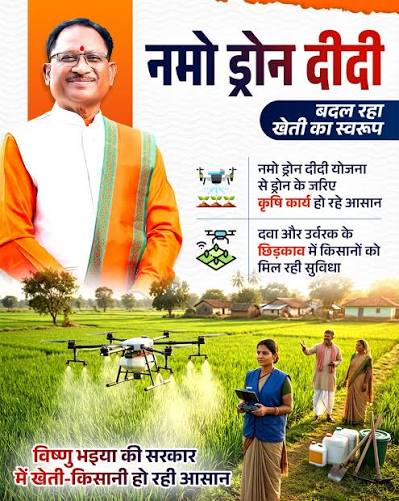
Young farmers are combining fish farming, poultry and horticulture, turning their farms into major centres of income. The use of drones, automatic reapers and modern agricultural equipment in rural areas is helping reduce labour costs while improving productivity.
Crop Production Records Significant Growth
During more than two and a half years of the Vishnu Deo Sai government, both the area under cultivation and agricultural production in the state have recorded notable growth.
According to official figures, production of Kharif crops has increased by around 17 per cent, while Rabi crop production has risen by approximately 20 per cent.
The change is not merely the result of cultivation across a larger area. Greater access to better seeds, fertilisers, irrigation and agricultural mechanisation has also played an important role in improving production.
Farmer Income and Economic Security Remain Key Priorities
The state’s agricultural policy is also focused on strengthening farmers’ incomes and providing greater economic security.
Under the Krishak Unnati Yojana, an input assistance amount linked to the minimum support price for Kharif paddy was paid to 24,73,762 farmers, amounting to ₹13,289 crore.
Under the Sugarcane Incentive Scheme, more than 1 crore 3 lakh 34 thousand quintals of sugarcane were procured, with ₹64.95 crore paid to 32,955 farmers.

Crop insurance coverage has also expanded, with more than 15.92 lakh farmers covered during the Kharif season and 2.99 lakh farmers during the Rabi season.
The Krishak Unnati Yojana has played an important role in strengthening farmers’ economic security. From Kharif 2023 to 2025, assistance of approximately ₹35,892.90 crore was directly transferred into the bank accounts of around 25.52 lakh farmers.
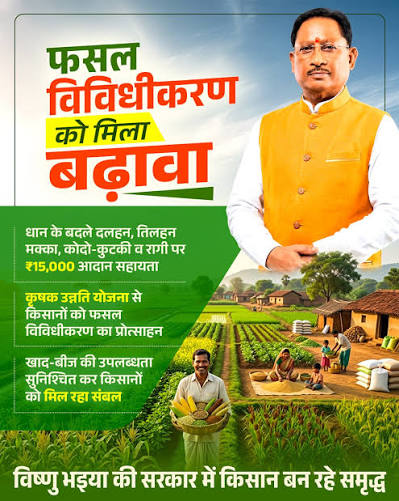
₹15,000 Per Acre Incentive to Promote Crop Diversification
Paddy remains the principal crop of Chhattisgarh, which has earned the state its identity as the Rice Bowl. However, the state government is now placing greater emphasis on crop diversification, encouraging farmers to cultivate a wider range of crops.
To promote diversification, farmers are being provided an incentive of ₹15,000 per acre.
The scheme promotes cultivation of pulses such as pigeon pea, moong, urad and gram, along with oilseeds including soybean, groundnut, sunflower and sesame.
Farmers cultivating maize, cotton and millets such as kodo, kutki, ragi and bajra are also eligible for the incentive.
Alongside strengthening farm incomes and reducing risks, the Pradhan Mantri Kisan Samman Nidhi has provided direct financial support to farmers. A total of ₹493 crore was transferred to 24.63 lakh farmers as the 23rd instalment, taking the cumulative amount transferred so far to more than ₹11,000 crore.
Technology Bringing Down Costs and Saving Water
The adoption of new technologies in agriculture is increasing rapidly across Chhattisgarh.
Farmers are increasingly adopting modern techniques, while Farm Machinery Banks in villages are making expensive agricultural machinery available to small farmers on rent. This is helping reduce both their workload and cultivation costs.
Under the Pradhan Mantri Krishi Sinchai Yojana, micro-irrigation technologies such as drip and sprinkler systems have expanded, helping save substantial quantities of water.
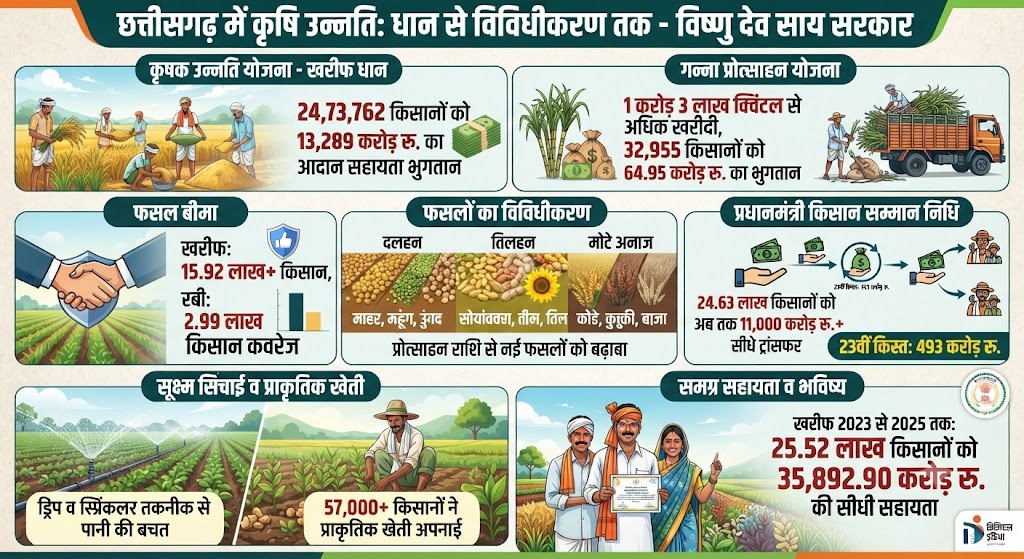
More than 57,000 farmers adopted natural farming last year, reflecting a growing focus on sustainable agricultural practices.
Horticulture Opens New Opportunities
Horticulture has emerged as another important chapter in Chhattisgarh’s changing agricultural landscape.
Over the past two and a half years, the area under horticulture has increased from 8.42 lakh hectares to 8.91 lakh hectares.
The expansion of fruits, vegetables, spices and flowers, along with crops such as oil palm and bamboo, is creating new opportunities for farmers.
The next challenge is to move beyond increasing production and connect farm output with markets, processing facilities and better prices.
In this direction, preparations are underway to develop infrastructure such as pack houses and Centres of Excellence, aimed at strengthening the agricultural value chain.
ALSO READ-
- Modern and Cash Crops Transform the Fortunes of Chhattisgarh Farmers
- Chirayu Scheme Brings New Hope to Durga and Mithilesh Battling Severe Spinal Deformities
- Over 1 Lakh Farmers Registered on AgriStack Under Special Drive in Rajnandgaon
- Surya Sabhas Held Across Rajnandgaon Villages to Promote PM Surya Ghar Scheme
- राजनांदगांव के जैन बगीचा में गूंजा “भगवान महावीर” की जय’ का जयघोष

