

More than 2.49 crore Ayushman cards issued; state health schemes provide coverage for hospital treatment and financial assistance for serious and rare diseases
Published on: November 25, 2026
By: Dhananjay Rathore Joint Director, Public Relations
Location: Raipur, India
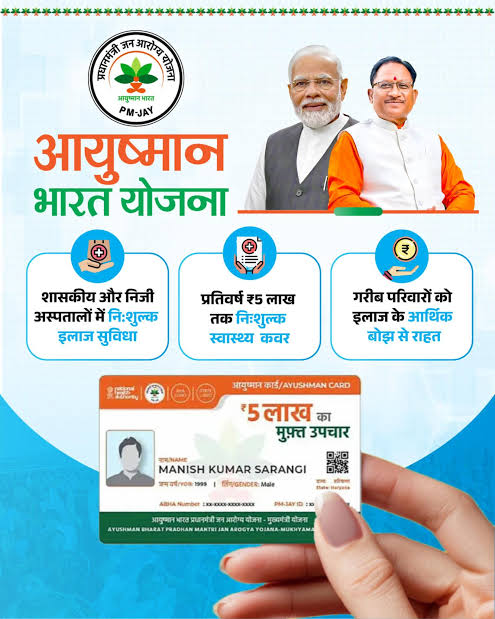
Health is the foundation of a society’s and state’s development. The Ayushman Bharat–Pradhan Mantri Jan Arogya Yojana, launched by the Government of India as the world’s largest health insurance scheme, is transforming healthcare access in Chhattisgarh.
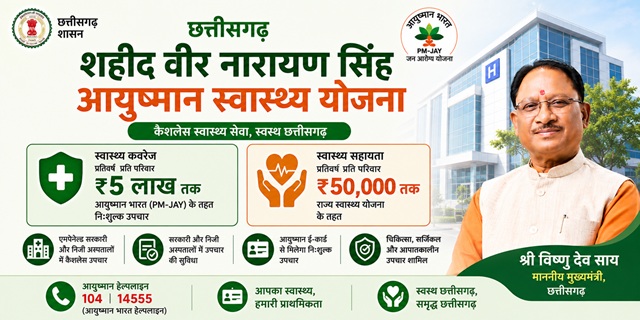
The scheme has been integrated with state health programmes and implemented as the Shaheed Veer Narayan Singh Ayushman Swasthya Yojana. Its primary objective is to protect eligible families from the heavy financial burden of treatment for serious illnesses.
Under the leadership of Chief Minister Vishnu Deo Sai, the scheme has emerged as a safety net for economically weaker sections and middle-class families who may struggle to afford expensive medical treatment. The Ayushman Bharat scheme and the Chief Minister’s Special Health Assistance Scheme provide support to citizens facing high healthcare costs.
Ayushman Cards: 91.9% of the Target Achieved
Chhattisgarh has expanded the scheme beyond the central beneficiary list, seeking to bring almost all families within its coverage through ration cards. Eligible families can access cashless treatment at registered government and private hospitals across the state and country.
Against a target of 2,71,11,762 Ayushman cards, a total of 2,49,18,115 cards have been issued, achieving 91.9% of the target. Surajpur district leads the state with 21,93,647 cards and 97% achievement.
Under Niyad Nellanar 2.0, 93% of ration-card-holding beneficiaries in the listed remote and formerly Maoist-affected districts have received Ayushman cards. In 2021, Chhattisgarh received four awards in four of the scheme’s six categories, including three for Ayushman card registration and one for gender equality.
Assistance of Up to ₹25 Lakh for Serious and Rare Diseases
Antyodaya, priority ration-card and centrally listed families receive health insurance coverage of up to ₹5 lakh per family annually. Other eligible general ration-card families can receive medical assistance of up to ₹50,000 under the state scheme.
For serious and rare diseases involving high treatment costs, the Chief Minister’s Special Health Assistance Scheme provides financial assistance of up to ₹25 lakh. It covers procedures such as liver and kidney transplants, heart treatment, cancer care, cochlear implants and rare genetic diseases. Funds are released directly to hospitals.
Since January 2024, assistance worth ₹203.07 crore has been approved for 3,281 beneficiaries. This includes ₹115.48 crore for 2,476 cancer cases, ₹27.06 crore for 205 bone marrow transplants, ₹17.18 crore for 686 dialysis cases and ₹17.08 crore for 371 cardiac treatments. Assistance has also been approved for 144 kidney transplants worth ₹5.41 crore and 31 liver transplants worth ₹5.57 crore.
Free Health Coverage for Senior Citizens
Under the Ayushman Vay Vandana Card, all senior citizens aged 70 years and above, irrespective of income or social status, receive health coverage of up to ₹5 lakh.
The scheme covers pre-existing diseases from the first day of card issuance. Benefits include hospitalisation-related expenses, medicines, pre-hospitalisation investigations and post-discharge follow-up.
Against a target of 8,71,717 cards, 6,23,220 Ayushman Vay Vandana cards have been issued, achieving 71.5%. Bastar district leads with 89.8% achievement.
ALSO READ-
- Hundreds of Rajnandgaon City Congress Leaders and Workers to Join Constitution Protection March in Raipur
- Ayushman Bharat Becomes a Healthcare Safety Net for Poor and Middle-Class Families in Chhattisgarh
- Administration Seizes 150 Bags of Paddy Along with Vehicle at Kallubanjari Checkpost
- Woman Allegedly Raped After Missing Train in Rajnandgaon; 32-Year-Old Accused Arrested
- Opposition to Mutton Market Relocation to Haat Bazaar; Hemant Ostwal Urges Mayor to Reconsider Decision
Healthcare Access in Remote Areas
Ayushman cards have helped bridge the gap for tribal and rural families who previously found treatment at expensive private hospitals difficult to afford. Residents of remote areas, including Bastar and Surguja, can now access treatment for cancer, heart disease, dialysis, knee replacement and neurosurgery at registered hospitals in Raipur, Bilaspur, Durg and other major cities.
At the village level, sub-health centres are being developed as Ayushman Arogya Mandirs, providing primary care, maternal and child health services, screening for diabetes and hypertension, and tele-consultation facilities.
Simple Digital and Offline Registration
Citizens can complete e-KYC and create or download their Ayushman cards through the Ayushman App or the official portal, beneficiary.nha.gov.in, using Aadhaar and ration-card details.
Cards can also be issued free of charge through nearby Common Service Centres (CSCs), Lok Seva Kendras and Ayushman Mitras at registered hospitals. Assistance and complaints can be directed to the state helpline 104 or national toll-free number 14555.
While millions have received cards and many have benefited from treatment, challenges remain. Greater awareness in rural areas, faster claim settlement by private hospitals and improved availability of specialist doctors in remote regions require continued attention.
Ayushman Bharat has become more than a government programme in Chhattisgarh. For poor and middle-class families, it represents a healthcare safety net aimed at ensuring that treatment does not stop because of a lack of money.